Vulnerability Management Policy Template: Tailored for Your Organization

As cyber threats become more sophisticated and regulatory scrutiny increases, organizations need a structured, repeatable approach to managing security risk. Failure to establish governance and oversight around risk management can lead to operational inefficiencies, security blind spots, and local decision-making that is misaligned with corporate risk tolerance.
These risks are especially prevalent in vulnerability management. One of the best ways to remove ambiguity across teams and standardize best practices for vulnerability management across an organization is to create a clear and concise template.
This article will walk you through creating a vulnerability management policy template tailored to your organization. It covers the essential policy template components for identifying, assessing, prioritizing, remediating, and continuously monitoring security vulnerabilities across an organization.
{{banner-small-3="/inline-cards"}}
Summary of key vulnerability management policy template components
The table below summarizes the eight components of a vulnerability management policy template that this article will cover in more detail.
Important: The policy components listed below represent a baseline for a standard vulnerability management program; however, this list is not exhaustive. Depending on your organization’s unique risk profile and the specific compliance or regulatory frameworks you operate under, additional policies may be required.
1. Purpose & objectives
This section explains why the vulnerability management policy exists and what it is designed to achieve. Start with a clear policy purpose statement that defines the goal of identifying, assessing, prioritizing, and remediating security vulnerabilities across your organization’s networks, hardware, software applications, endpoints, and cloud environments. The purpose should clearly define the digital boundaries covered by the policy so there is no confusion about the scope.
Next, describe the business and security objectives. These may include reducing the organization’s attack surface, minimizing the time that systems are exposed to known vulnerabilities, protecting customer data, and meeting regulatory requirements. The objectives should align with your overall risk management strategy by showing how vulnerability management supports risk reduction and business continuity.
You should also explain how this policy connects with other security policies, such as incident response, patch management, and asset management. Finally, define high-level success criteria, such as meeting defined remediation timelines, maintaining a certain compliance rate, and continuously improving vulnerability metrics over time.
2. Roles & responsibilities
This section explains who is accountable at each stage of the vulnerability management lifecycle. Clear role definitions prevent ownership gaps and ensure vulnerabilities move from detection to remediation without delay.
This part of the template should clearly state that every vulnerability must have an assigned owner from discovery to closure. It should define that responsibility cannot remain undefined at any stage of the process.
The table below summarizes the key roles and their responsibilities across the vulnerability management lifecycle:
3. Vulnerability discovery & scanning
This section of a vulnerability management policy template explains how the organization identifies vulnerabilities across its environment. The goal is to ensure consistent and repeatable scanning so that new and existing risks are always visible. A defined discovery process reduces blind spots and helps detect emerging threats early.
Scan Types: The template should clearly define the types of scans performed. This may include network scans of servers and devices, application scans of web applications and APIs, container scans of images, cloud configuration reviews, and code scanning, such as SAST or SCA, during development. Each scan type should state what assets are covered and at what stage of the system lifecycle the scan occurs.
Scan Frequency by Asset Type: The policy should specify how frequently each asset type is scanned. Internet-facing systems may require weekly or continuous scanning, while internal systems may be scanned monthly or quarterly, depending on risk. Defining frequency by asset category ensures higher-risk systems receive more attention.
Authenticated vs. Unauthenticated Scanning: The template should explain when to use authenticated and unauthenticated scans. Authenticated scans use approved credentials to log into systems and provide deeper visibility into missing patches, software inventory, and configuration issues. Unauthenticated (or "network") scans do not use credentials and simulate an attacker's vantage point from a machine on the network, identifying what services and vulnerabilities are visible without login access. These are distinct from internal vs. external scans, which refer to where the scanner is positioned relative to the network boundary. Many organizations require a combination of scan types for complete coverage.

Tooling Standards: The policy should specify which vulnerability scanning tools are approved and who is responsible for managing them. This ensures consistent configuration, proper access control, and reliable reporting. Tool ownership should also include responsibility for updates, tuning, and integration with ticketing or reporting systems.
False Positive Handling: The template should describe how suspected false positives are reviewed and validated. It should define who is authorized to mark a finding as invalid and how that decision is documented. This prevents unnecessary remediation work while maintaining audit traceability.
Change-Driven Scans: The policy should require additional scans after significant system changes. Examples include new system deployments, major upgrades, infrastructure changes, or cloud configuration updates. Change-driven scans help confirm that new vulnerabilities were not introduced during the change process.
{{banner-small-2="/inline-cards"}}
4. Vulnerability risk assessment & prioritization
This section explains how vulnerabilities are evaluated and ranked before remediation. A clear prioritization method ensures that critical risks are addressed first and prevents teams from spending time on low-impact issues while serious threats remain open.
Severity Scoring Model: The template should define the scoring method used to measure technical severity, such as the CVSS associated with a specific CVE. It may also include EPSS to estimate the likelihood of exploitation and business risk ratings to reflect operational impact. For example, a vulnerability with a high CVSS score but low business impact may be ranked differently than one affecting a revenue-generating system.

Asset Criticality Weighting: The policy should explain how asset importance affects prioritization. Systems that handle sensitive data, customer transactions, or core operations should receive higher weighting. For example, the same vulnerability on a test server may be lower priority than on a production payment system.
Exploit Availability: The template should require consideration of whether public exploits exist or active attacks are observed. A medium-severity vulnerability with known exploit code may be treated as a high-priority issue due to increased risk.
Threat Intelligence Integration: The policy should describe how external threat intelligence feeds or internal monitoring data influence prioritization. If threat intelligence shows active targeting of a specific vulnerability in your industry, the remediation priority should increase.
Risk Categorization Tiers: The template should define clear risk levels such as Critical, High, Medium, and Low. Each tier should have defined response expectations and remediation timelines to ensure consistency across teams.
Prioritization Workflow: The policy should describe the step-by-step process for reviewing findings, adjusting risk scores based on business context, and assigning remediation tasks. This ensures that prioritization decisions are documented, consistent, and aligned with overall risk management strategy.
5. Remediation & mitigation requirements
This section explains how identified vulnerabilities must be resolved and within what timeframe. It defines clear remediation timelines and Service Level Agreements so teams understand their obligations. This ensures that critical risks are fixed quickly and consistently across the organization.
Remediation Timelines by Severity: The template should define how fast vulnerabilities must be resolved based on their risk level. For example, Critical vulnerabilities may require remediation within 7 days, High within 30 days, Medium within 60 days, and Low within 90 days. These timelines should align with business risk tolerance and compliance requirements.
Approved Remediation Methods: The policy should describe acceptable methods for resolving vulnerabilities. This may include applying vendor patches, upgrading software versions, changing configurations, disabling vulnerable services, or updating code. The template should state that remediation actions must follow change management procedures to protect system stability.
Temporary Mitigation Options: In cases where a permanent fix is not immediately available, the policy should allow temporary controls. For example, blocking network access through a firewall rule or disabling a vulnerable feature may reduce exposure until a patch can be applied. The template should require formal documentation and approval for temporary mitigations.
Validation Requirements: The policy should define how remediation is verified. This may include rescanning the asset, reviewing configuration settings, or confirming patch installation. A vulnerability should not be marked as closed until validation confirms the issue is resolved.
Escalation for Missed SLAs: The template should define what happens when remediation deadlines are not met. This may include automatic notification to management, formal risk acceptance approval, or executive escalation for critical findings. Clear escalation rules reinforce accountability and prevent overdue vulnerabilities from being ignored.
{{banner-large-3-vciso="/inline-cards"}}
6. Exception handling & risk acceptance
This section explains how unresolved vulnerabilities can be formally accepted when immediate remediation is not possible. It ensures that risks are not ignored and provides a controlled process for managing exceptions, reducing the chance of unmanaged exposure and audit issues.
Exception Request Workflow: The template should describe how teams request an exception. For example, a system owner may submit a form explaining why a patch cannot be applied, the expected impact, and proposed mitigations. This workflow ensures requests are documented and tracked.
Risk Justification Requirements: Each exception should include a clear explanation of why the vulnerability cannot be fixed immediately. This may cover business impact, technical constraints, or dependencies on critical applications, helping reviewers understand the context for risk acceptance.
Approval Authority: The policy should define who can approve exceptions. For critical systems, approval may require a senior leader such as the Chief Information Security Officer. Lower-risk exceptions might be approved by the security manager or IT lead, depending on the organization’s structure.
Expiration and Review Cycle: Exceptions should have a defined expiration and require periodic review. For example, an approved exception may be valid for 90 days, after which it must be re-evaluated or closed. This prevents long-term accumulation of unaddressed vulnerabilities.
Compensating Controls Documentation: The template should require documentation of temporary measures that reduce risk while the vulnerability remains unpatched. Examples include firewall rules, network segmentation, or access restrictions. This ensures that even accepted risks are managed responsibly.
7. Reporting & metrics
This section defines how the vulnerability management program tracks performance and communicates results. Clear metrics help teams improve processes over time, while providing executives and auditors with visibility into risk posture and remediation effectiveness.
Mean Time to Remediate (MTTR): The template should define how the average time to fix vulnerabilities is calculated. MTTR provides a clear measure of how quickly the organization addresses risks, helping identify bottlenecks or delays in the process.
SLA Compliance Rates: The policy should track the percentage of vulnerabilities remediated within the defined timelines. For example, the template may report that 95% of High-severity vulnerabilities were fixed within 30 days, showing adherence to SLAs.
Vulnerability Aging Metrics: This includes reporting on how long vulnerabilities remain open by severity or asset type. For example, identifying Critical vulnerabilities that have been open longer than 7 days helps focus attention on overdue risks.

Scan Coverage Metrics: The template should measure how much of the environment is actually being scanned. Metrics can show the percentage of servers, applications, cloud services, and endpoints scanned regularly, helping ensure visibility across all assets.
Risk Trend Analysis: The policy should track trends over time, such as the number of new vulnerabilities discovered per month, recurring issues, or changes in severity distribution. Trend analysis helps predict emerging risks and measure the effectiveness of remediation efforts.
Executive Dashboards: The template should define how key metrics are presented to leadership. Dashboards may include high-level charts, top risks, SLA performance, and trend indicators, providing executives with a clear view of the organization’s security posture without overwhelming technical detail.
8. Compliance & regulatory alignment
This section explains how the vulnerability management policy aligns with relevant laws, standards, and frameworks. Clear mapping ensures the organization is audit-ready and maintains consistent security practices across regulatory requirements.
Framework Mappings: The template should show how the policy supports recognized frameworks such as ISO 27001, NIST, CIS Controls, SOC 2, or CMMC. For example, the policy may reference ISO 27001’s A.12.6.1 requirement for technical vulnerability management and indicate which parts of your program satisfy it.
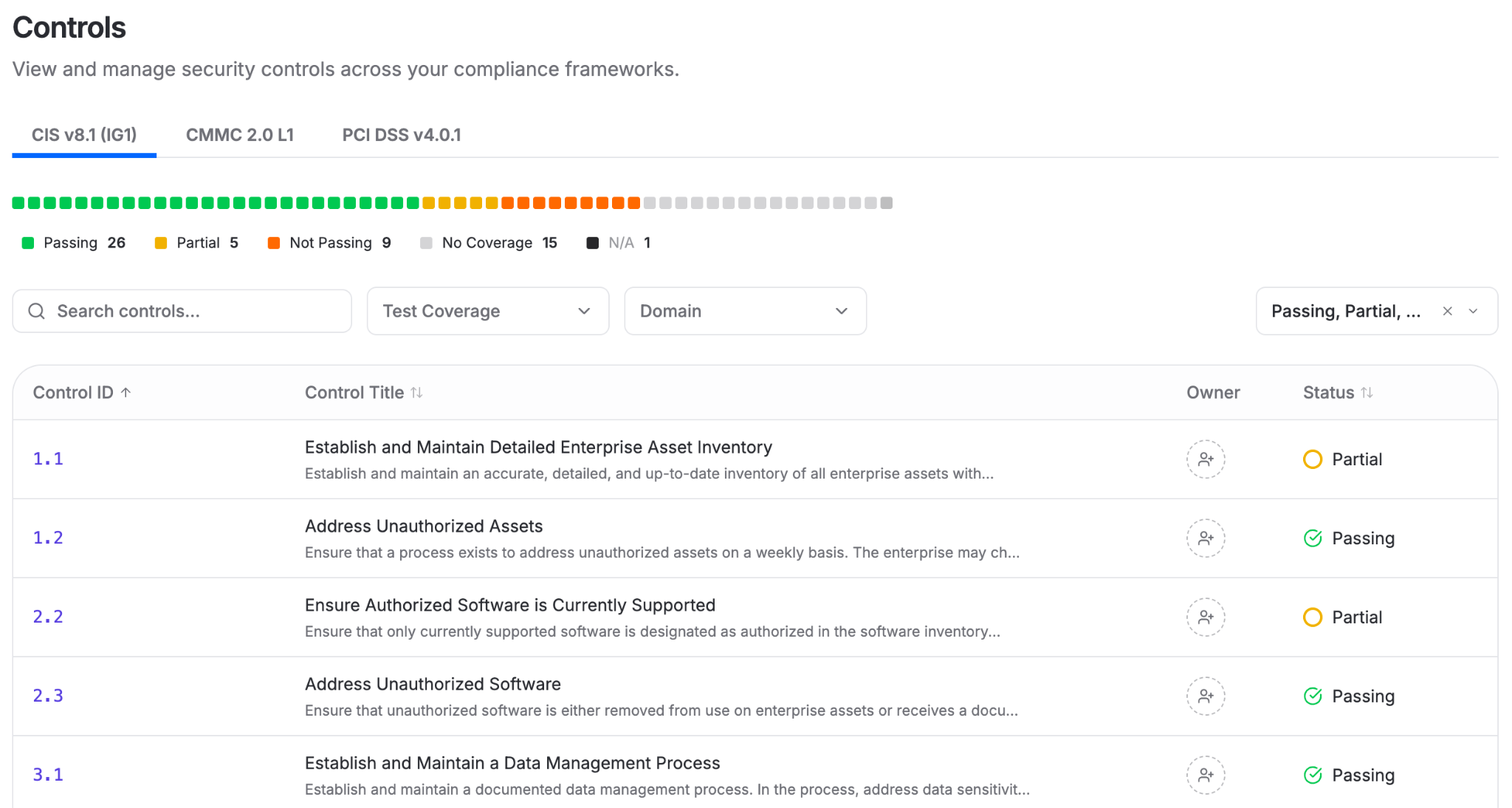
Control References: Each vulnerability management process should be linked to specific controls in the framework. For example, patch management, exception handling, and scanning procedures can reference corresponding NIST SP 800-53 or CIS Controls identifiers. This helps auditors verify compliance easily.
Audit Ownership: The policy should define who is responsible for audits and evidence collection. This ensures accountability for demonstrating that processes are followed and helps prevent gaps during internal or external reviews.
Evidence Mapping: The template should document what evidence is required to show compliance. This may include scan reports, remediation logs, exception approvals, and SLA metrics. Mapping evidence to controls simplifies audit preparation and supports regulatory reporting.
{{b-table-3-vciso="/inline-cards"}}
Final thoughts
The true value of a vulnerability management policy template isn't just in the document itself, but in the standardization of institutional memory. Without a formal template, security becomes "tribal knowledge". In other words, fragmented, inconsistent, and prone to human error. A well-constructed template transforms reactive, frantic patching into a repeatable, defensible business process.