ConnectSecure Alternative: How Cyrisma Compares for MSP Vulnerability and Compliance Management
Compare Cyrisma vs. ConnectSecure for MSPs across vulnerability scanning, real-time monitoring, workflow automation, integrated GRC/vCISO, and patch coverage (10,000+ vs. 600+ apps)

The role of the managed service provider (MSP) in cybersecurity operations has changed substantially over the past several years. Where MSPs once delivered value primarily through vulnerability scanning and periodic compliance reporting, client expectations now extend into continuous monitoring, automated remediation, workflow orchestration, and strategic security advisory. The 2025 Verizon Data Breach Investigations Report documented a 34% year-over-year surge in vulnerability exploitation as an initial access vector, and most organizations now manage six or more compliance frameworks simultaneously. These pressures compound for MSPs operating across dozens or hundreds of client environments, each with its own infrastructure, risk tolerance, and regulatory obligations.
Both Cyrisma and ConnectSecure serve this market, and both provide meaningful capabilities for vulnerability management, compliance scanning, and risk-based prioritization. The two platforms diverge, however, when the evaluation extends beyond foundational scanning into the operational capabilities that determine how efficiently an MSP can deliver security outcomes at scale. Real-time monitoring, granular workflow automation, integrated governance and compliance delivery, and the breadth of automated patch remediation represent areas where architectural differences between the platforms carry direct consequences for margin, scalability, and the range of services an MSP can offer from a single tool.
This article presents a structured comparison across seven core capability areas. The first three represent domains where both platforms deliver, with Cyrisma's differentiated strengths noted within each. The remaining four address capabilities where Cyrisma extends beyond what ConnectSecure currently offers, each tied to a measurable MSP business outcome: increased margin through operational efficiency, remediation advantage through patch automation breadth, and tool consolidation through platform unification.
Summary of key ConnectSecure alternative concepts
The table below compares Cyrisma and ConnectSecure across eight key capabilities which this article will explore in more detail.
1. Vulnerability & compliance assessments
The ability to scan client environments, identify known vulnerabilities, and map findings against regulatory frameworks is the foundational capability upon which every MSP security practice is built. Without it, there is no vulnerability or compliance-as-a-service offering, no risk quantification, and no evidence basis for remediation prioritization. Both Cyrisma and ConnectSecure deliver this capability, and MSPs selecting either platform will have the scanning and compliance mapping layer they need to operate.
Where the two platforms differ is in how they organize and present that information. ConnectSecure provides deep per-asset technical inventory, capturing over 15 data categories per endpoint along with dedicated firewall intelligence that surfaces rules, interfaces, and license details. It is worth noting, however, that much of this per-endpoint granularity, including hardware specifications, installed software inventories, and network interface details, falls into the asset inventory and endpoint telemetry category that most MSPs already collect through their RMM platforms. In environments where tools such as ConnectWise Automate, Datto, or NinjaOne are already deployed, the incremental value of duplicating this telemetry within a vulnerability management platform is limited.
On the compliance side, ConnectSecure supports 13 automated scanning frameworks plus over 20 questionnaire-based assessments, and its Business Assessment module supports MSP sales enablement. Furthermore, ConnectSecure covers several niche frameworks that Cyrisma does not currently address, including HITRUST, FADP, WISP IRS, and all nine PCI DSS SAQ types.
Cyrisma approaches the same problem from a fleet-level perspective. Rather than optimizing for per-asset depth, the platform surfaces organization-wide health metrics, including EDR coverage rates, encryption status, and agent deployment gaps, through a unified posture dashboard. Assets can be tagged with business context such as owner, department, and compliance applicability, which links technical findings to organizational structure.
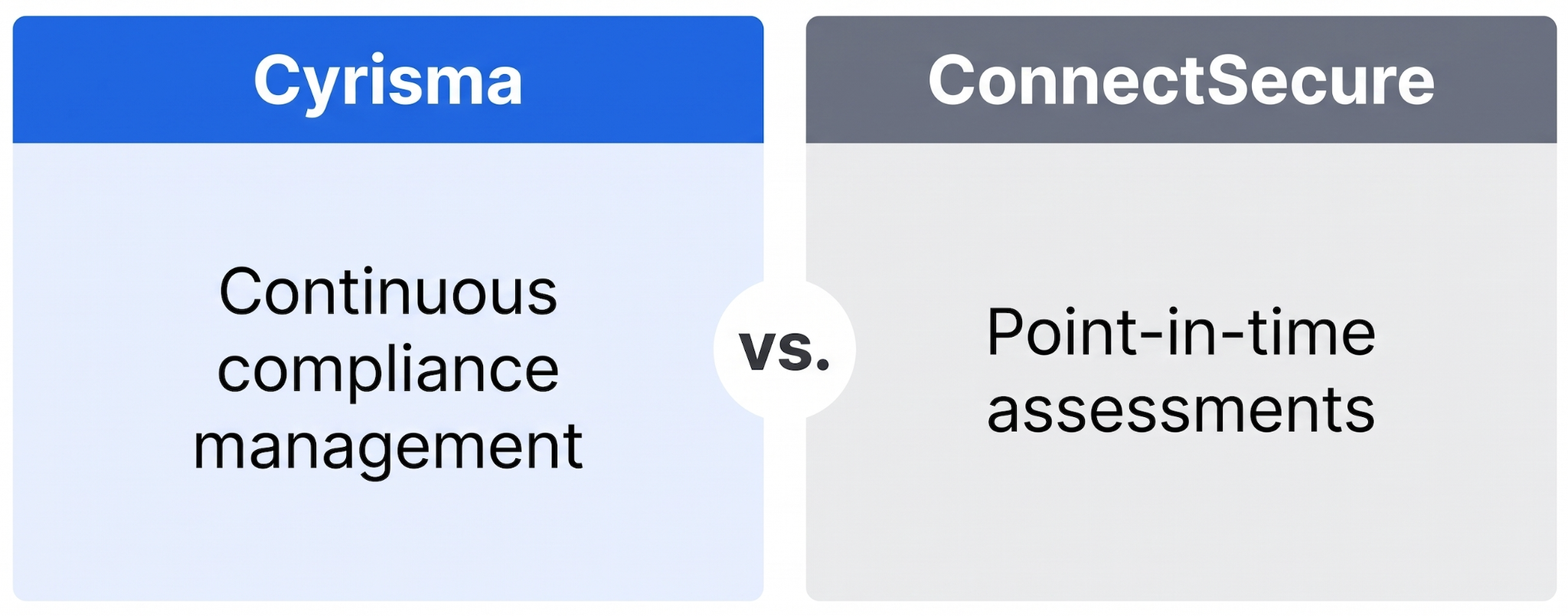
Beyond asset-level differences, there is an important architectural distinction to draw on how each platform handles compliance. Both platforms offer compliance assessments in the traditional sense, namely the ability to evaluate controls against framework requirements and produce yes/no/partial scores. Where Cyrisma diverges is in extending beyond point-in-time assessments into continuous compliance management, a category more comparable to dedicated GRC platforms such as Vanta or Drata than to vulnerability management tools. The table below details the specific capabilities this encompasses, but the key difference is structural: Cyrisma treats compliance as an ongoing operational process with automated tests, policy governance, evidence collection, and risk tracking, rather than a periodic assessment exercise. For organizations managing multiple overlapping frameworks, this cross-mapping approach significantly reduces duplicate effort by allowing shared controls to be assessed once rather than separately for each framework.
The following table summarizes the specific compliance and assessment dimensions where the two platforms differ:
The practical distinction operates on two levels. On the asset side, ConnectSecure's per-endpoint granularity is strongest in areas that overlap with RMM-tier telemetry, which many MSPs already collect through existing tools. On the compliance side, ConnectSecure provides point-in-time assessments, whereas Cyrisma provides a continuous compliance management platform with the GRC capabilities detailed in the table above.
For MSPs whose service delivery model stops at periodic compliance assessments, either platform covers the requirement. For MSPs building compliance programs that require ongoing evidence, policy governance, and audit readiness, Cyrisma addresses that scope without requiring supplemental tooling.
2. Endpoint, network, external, and web app scanning
Vulnerabilities do not confine themselves to endpoints. Network devices, externally facing infrastructure, and web applications each represent distinct attack surfaces that require specialized scanning approaches. For MSPs, multi-vector scanning coverage directly determines how much of a client's actual attack surface the platform can assess.
Both platforms provide scanning across endpoints, network devices, external infrastructure, and web applications. ConnectSecure organizes its scanning across six asset categories with significant technical depth per asset, and its dedicated firewall scanning module provides granular visibility into firewall rules, interface configurations, and license states. This depth serves MSPs whose client engagements involve detailed firewall audits or device-level configuration reviews.
Cyrisma covers 10 asset categories, extending into ChromeOS devices, cloud instances, and web URLs alongside the standard endpoint, network, and external scanning vectors. The broader asset category coverage means more of a client's environment falls within the scope of a single scan configuration, which reduces the number of supplemental tools or manual processes needed to achieve full-surface visibility. Moreover, Cyrisma presents internal and external scan results in a unified view, reducing the context-switching that occurs when technicians move between separate scanning interfaces to correlate findings.
Scanning breadth also has a direct relationship to compliance automation: every additional scan vector that a platform covers is a set of controls that can be assessed programmatically rather than through manual evidence collection. For MSPs delivering compliance services across large client portfolios, the operational cost savings of automated control assessment compound with each additional framework and each additional client.
3. Risk-based prioritization
A single vulnerability scan of a moderately complex client environment can produce hundreds or thousands of individual findings. Without effective prioritization, technicians face a flat list of issues with no clear indication of where to begin, and the most operationally damaging outcome is not that findings go unfixed, but that they get fixed in the wrong order. Industry data consistently shows that the median time to remediate vulnerabilities stretches well beyond 30 days, while the average time from disclosure to active exploitation has compressed to single-digit days. This gap underscores why prioritization methodology matters as much as scanning capability.
ConnectSecure provides risk scores at the individual asset level with detailed technical context, which helps technicians answer the immediate question of which specific endpoint or device to address first. The scoring accounts for vulnerability severity and exposure factors, and the per-asset presentation aligns well with workflows where remediation is performed on a device-by-device basis.
Cyrisma integrates its risk scoring with the broader compliance and governance context that the platform maintains. Findings are weighted not only by technical severity and exploitability but also by their relationship to compliance framework controls and business-critical asset classifications. In practice, this means that a vulnerability affecting a system tagged as in-scope for CMMC Level 2 and owned by a regulated business unit will surface differently than an identical vulnerability on an out-of-scope development workstation. This layered approach connects prioritization to the business and regulatory context that ultimately determines which risks carry the most consequential exposure.
The value of any prioritization model, however, is realized only when it leads to efficient remediation. Where Cyrisma's approach becomes particularly relevant is in how it feeds prioritized findings into downstream capabilities: automated patching, compliance score updates, and governance reporting all consume the same prioritization data. This creates a closed loop where the act of remediating a high-priority finding automatically updates compliance posture and executive-facing dashboards, without requiring manual reconciliation between separate systems.
4. Real-time vulnerability & configuration monitoring
The urgency of real-time monitoring for MSPs has intensified considerably as threat actors have compressed the window between vulnerability disclosure and active exploitation. The time between a vulnerability being disclosed and actively exploited in the wild has shrunk from weeks to hours in many cases, particularly for internet-exposed remote access infrastructure. When the vulnerabilities in question affect the very tools MSPs rely on to manage client environments, the consequences of delayed detection become severe. The following recent incidents illustrate why:
In each of these cases, the MSPs that could identify affected clients within minutes had a materially better response posture than those waiting for the next scheduled scan or daily vulnerability database enrichment.
A platform that relies exclusively on periodic scanning captures a point-in-time snapshot, and that snapshot begins degrading the moment it is taken. Scheduled scanning cycles leave systems exposed between assessments. The operational cost of this model extends beyond general security posture into the specific scenario that matters most: when a critical vulnerability drops in an MSP-adjacent tool or edge device, a scheduled-scan architecture cannot answer the question "which of my clients are exposed right now?" until the next scan completes and the next database enrichment propagates. For an MSP managing hundreds of client environments, that delay can represent hours or days of unidentified exposure across the entire managed portfolio.
Cyrisma's continuous monitoring architecture addresses this by reflecting vulnerability status, configuration compliance, and endpoint health in real time. When a new vulnerability is identified in the platform's threat intelligence feeds, affected assets across all managed environments surface immediately rather than waiting for the next scan window. This positions Cyrisma as an early-warning system across the MSP's entire client base, providing the kind of immediate cross-environment visibility that is essential when a vulnerability affecting widely deployed MSP tooling or edge infrastructure enters active exploitation.
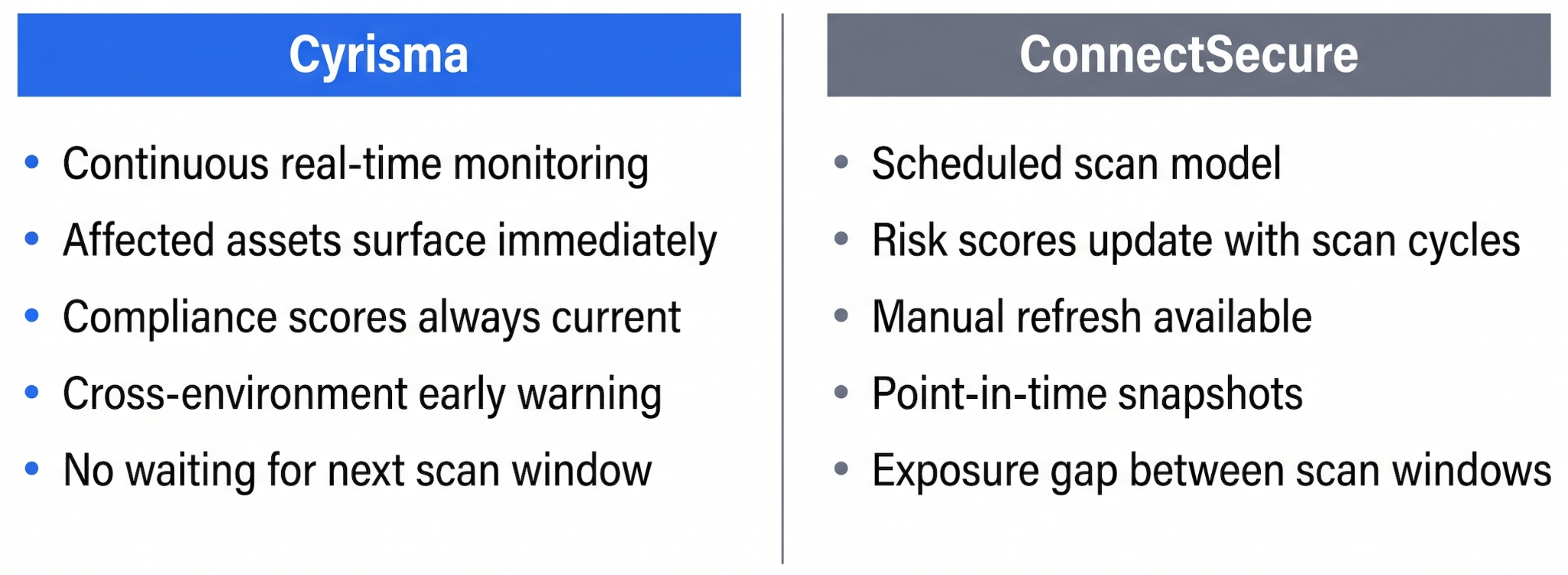
Policy approvals, evidence uploads, and configuration changes similarly update platform state without delay, so compliance scores, executive dashboards, and trending reports stay current. ConnectSecure operates on a scheduled scan model where risk scores update with scan cycles and manual refresh is available. This approach works for periodic assessments, but it doesn't provide the immediate detection capability the current threat landscape demands.
For MSPs at scale, the margin and security implications of this difference converge. The distinction between "re-scan everything to produce fresh data" and "data is already current" translates into recovered hours across every reporting cycle and audit interaction. More critically, when a vulnerability in MSP infrastructure or edge devices is actively exploited, real-time monitoring is the difference between proactive client notification and reactive incident response.
5. Granular ticketing & alerting workflows
Scanning produces findings, but the operational question that determines whether those findings translate into security outcomes is what happens after identification. In MSP environments managing dozens or hundreds of clients, findings without automated workflows become lists that require manual triage, assignment, escalation, and tracking for every item across every client and every scan cycle. This manual overhead is a substantial but often overlooked cost driver in MSP security operations.
There is a meaningful distinction between "the platform sends alerts" and "the platform provides granular alerting workflows." Basic alerting notifies an operator when a threshold is crossed. Granular workflow automation, by contrast, allows an MSP to define per-client, per-severity, and per-category rules that determine how a finding routes to the appropriate team, generates the appropriate ticket, and triggers the appropriate response action. The difference is the distance between a notification and an orchestrated operational response.
Cyrisma provides configurable workflow rules that automate the full path from finding discovery to assignment to resolution tracking. MSPs can build rules that reflect each client engagement's operational requirements, so a critical vulnerability finding in a healthcare client's environment can automatically generate a ticket with HIPAA-specific context and route it to the compliance-aware remediation team, while the same severity finding in a less regulated environment follows a different path. This granularity separates a scanning tool from an operational platform. ConnectSecure does not currently include granular ticketing or alerting workflow capabilities, so MSPs must manage finding triage and assignment through external tools or manual processes.
The margin implications of this capability are relatively straightforward to quantify. Every manual step from finding to resolution adds cost, multiplied by the number of clients, scan cycles, and findings per cycle. Automating these workflows is one of the most effective ways to reduce per-client operational cost, and integrating ticketing and alerting into the same platform that performs scanning and compliance mapping means the entire workflow runs end-to-end without export, import, or context-switching between systems.
6. Integrated vCISO and GRC platform
The MSP market is undergoing a significant structural shift toward strategic security advisory services. According to Cynomi's 2025 State of the vCISO Report, adoption of vCISO service offerings among MSPs and MSSPs surged from 21% in 2024 to 67% in 2025, representing a 319% year-over-year increase. The virtual CISO market, valued at approximately $1.4 billion in 2024, is projected to reach $3.8 billion by 2033. This growth is consistent across multiple data sources. It reflects a structural market shift: clients increasingly expect governance, policy management, compliance program oversight, and executive-level security communication as part of their managed security engagement, not as a separate engagement with a separate provider.
The operational challenge for MSPs pursuing this opportunity is tool fragmentation. When vulnerability scanning runs in one platform, policy management lives in SharePoint or Confluence, compliance tracking resides in spreadsheets, ticketing in the PSA, and executive reporting is assembled in PowerPoint, the MSP absorbs the full integration burden. Data does not flow between systems, metrics do not connect, and every client deliverable requires manual assembly. The cost of this fragmentation is well documented across the industry, both in direct breach costs for organizations with complex security stacks and in margin erosion from the operational overhead of maintaining disconnected tools.
Cyrisma addresses this fragmentation by integrating governance, risk, and compliance capabilities into the same platform that performs vulnerability scanning and remediation. The GRC layer includes a full policy lifecycle with template-based creation, owner assignment, approval workflows, version control, and employee acknowledgment tracking. Currently, more than 55 policy-based controls feed directly into compliance scores, so a policy approval automatically improves the corresponding framework assessment.
Strategic planning and roadmapping capabilities allow MSPs to align security program initiatives with business objectives, prioritize by risk, and track progress. Board-level communication is supported through a unified program dashboard spanning 24 control domains with integrated metrics across controls, tests, policies, and evidence.
ConnectSecure provides strong technical reporting, including over 110 pre-built reports, AI-generated narratives, and a drag-and-drop report builder, along with compliance scanning across 13 automated frameworks and over 20 questionnaire-based assessments. These are valuable capabilities for technical and compliance reporting.
The platform does not, however, include an integrated governance, policy management, or strategic planning layer. MSPs delivering vCISO-tier services through ConnectSecure must supplement with external tools for policy lifecycle management, compliance program governance, and executive-level program communication. For MSPs expanding into this rapidly growing service category, Cyrisma removes the need to assemble a multi-tool stack by running vulnerability operations and governance delivery on the same platform, with the same data, in the same workflow.
7. Patch coverage
While vulnerability scanning identifies where problems exist, it is patching that resolves them, and for MSPs, the gap between detection and remediation is precisely where operational cost accumulates and client risk persists. Median remediation times for known vulnerabilities consistently exceed 30 days across the industry, and for critical vulnerabilities in complex environments the timeline stretches even longer. Meanwhile, the average time from vulnerability disclosure to active exploitation has compressed to days rather than weeks. These dynamics describe an environment where automated patch remediation is not an operational convenience but a security necessity.
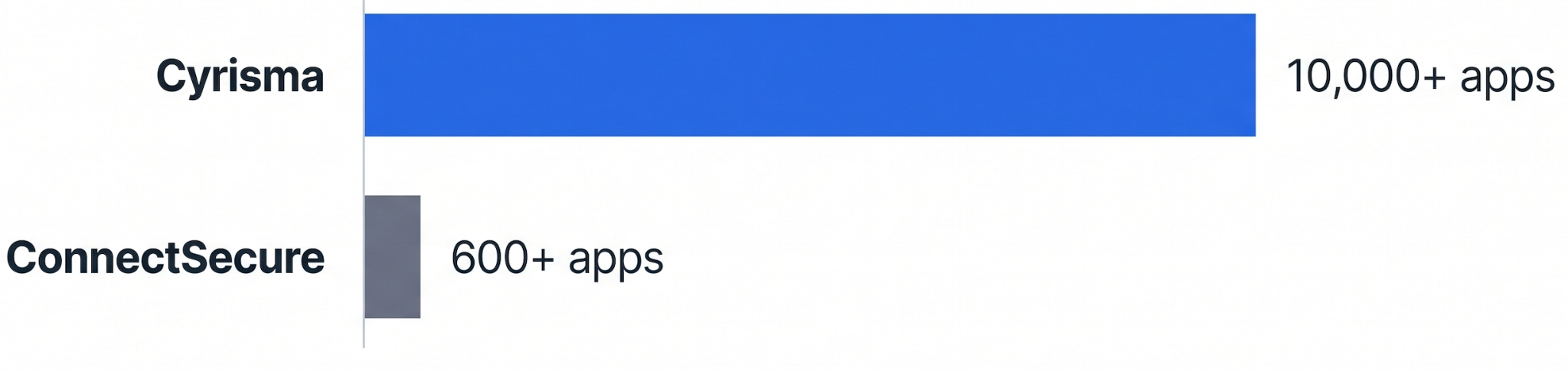
The quantitative difference in patch coverage between the two platforms is substantial. Cyrisma supports automated patching for over 10,000 third-party applications. ConnectSecure supports over 600 third-party software titles, according to its published application patching documentation. This represents approximately a 16-to-1 difference in the number of applications an MSP can remediate without leaving the platform. The practical significance of this gap becomes clear when considering the composition of real-world vulnerability exposure: operating system patches are generally well-handled by existing RMM tools, but the long tail of third-party applications, including browsers, plugins, productivity suites, development tools, and industry-specific software, is where exploitable vulnerabilities concentrate and where most MSPs have persistent coverage gaps.
The table below compares the patching and remediation capabilities of both platforms.
The operational significance of these differences extends beyond the numbers in the table. Broader patch coverage combined with policy-driven automation changes the fundamental workflow. Instead of technicians manually identifying and deploying patches for a limited set of supported applications, MSPs define remediation policies once and execute them automatically across the managed portfolio. Moreover, because patching is integrated with the same platform that tracks vulnerability and compliance status, each successful deployment automatically closes the corresponding finding and updates framework scores without manual reconciliation.
For MSPs evaluating these platforms, patch coverage is the most straightforward differentiator to quantify: a 16-to-1 difference in supported applications translates directly into more vulnerabilities closed, faster, with less manual effort, and with measurable impact on both security outcomes and margin per client.
Conclusion
Both Cyrisma and ConnectSecure meet the foundational requirements of vulnerability scanning, multi-vector coverage, and risk-based prioritization, and ConnectSecure brings genuine strengths in per-asset technical depth, niche framework coverage, and reporting. The platforms differ in the operational layer above those foundations: real-time monitoring, workflow automation, continuous compliance management, and the breadth of automated patch remediation across 10,000+ third-party applications.
For MSPs whose client portfolios are growing and whose service model is expanding into compliance programs and strategic advisory, the question is whether the platform can scale with them or whether supplemental tooling is required to fill the gaps. On that measure, Cyrisma covers more of the operational lifecycle from a single platform. In a market where vCISO adoption has tripled in a single year, and the window between vulnerability disclosure and exploitation continues to shrink, that distinction carries practical weight.


Latest updates
View allTurn risk and compliance into revenue
Get a Demo